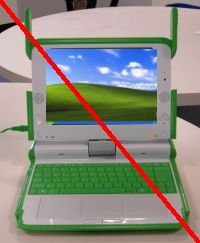
LMAO.We still haven't seen anything beyond BTest-2 of OLPC's impending XO laptop, but Jürgen Rink over at heise mobil has an in-depth rundown of the project, the laptop and the competition. There's much to be said, eight pages of it, in fact, but Jürgen provides some interesting insights into what sets the XO's tech apart from current laptops and other entrants in the educational laptop space. He also makes it quite clear that the XO has a ways to go, with power consumption -- which Nicholas Negroponte is targeting at 2 watts -- currently ranging from 6.5 to 9.1 watts, and the battery life at 2.5 to 3.5 hours falls far short of the projected 10 hours. Also MIA is the back light sensor, and that much talked about pull-string power generator hasn't even hit prototype stages yet. There are concerns that the convertible display hinge will prove to fragile under heavy use, and software holes like security and missing apps will need to be fixed before the laptop is ready for prime time. That said, the laptop provides some pretty interesting advancements in the realm of hardware and software, with notables like the reflective display, mesh networking, stylus-friendly trackpads and the "kids teach themselves" concept differentiating the XO from edu-PC wannabes. The project still hasn't reached its moment of truth, when verbally-committed governments have to start ponying up cash, but the first order of business is wrapping development on the XO, and we look forward to peeping the final product. -- via Engadget
Friday, 11 May 2007
OLPC rundown: XO gets naked, project detailed
Friday, 20 April 2007
Quanta to delay OLPC notebook shipments to 4Q07
Quanta Computer's shipments of XO notebooks under the OLPC (One Laptop per Child) project may be delayed, again, to the fourth quarter instead of the third quarter due to a delay in designs of varied application scenarios for different emerging markets, according to an April 20 Chinese-language Commercial Times report.
Okay, so it is REALLY hard to make a decent $150 laptop and the pessimistic folks at Merrill Lynch might really got it right.
Btw, has anyone checked the secondhand chinese market? I got a IBM x21 for $200 last month, and it's operating system is (Windows 2000) not as gay as the OLPC sugar.
Thursday, 19 April 2007
Bill made the wrong move, again.
Finally, Mr. Microsoft finally announced his big plan today of making his (otherwise available for free on p2p) application suites for $3, exclusively to the children in "qualified poor countries". He might have read my paper few weeks ago, but sadly enough, he didn't get it.
gle Web 2.0 suite the other day, and I clearly saw why Paul declared the death of Microsoft. Christensen is ultimately right, giant tech leaders always found themselves in extremely difficult situations when it comes to "dump the old crap" and make something new and better - at least this appears to be those well paid MS managers' last concern.
The interesting (and possibility good) thing is, when a market player of this size make a move, many others will jump on the wagon. Among "the others" we are likely to see some true innovators that finally has the courage, knowledge and resource to get things right.
- First, not just poor child in poor countries need a decent personal technology platform - a.k.a a nice little thin client laptop; instead, people who can get most of the instant bangs from a nice cheap laptop are digital divide victims in the developing world.
- Second, he made it as a charity - and charity is the biggest pile of bullshit that has a sole purpose to entertain the rich donors. It could NEVER be effective, nor sustainable. Why Bill is doing this ? Two words: total control. If he did this in the private sector, i.e. to supply cheap apps for OEM manufacturers who makes sub-$200 laptops, things could go out of control quickly. But this is a donation, a charitable initiative which Bill can pull the plug anytime he wishes.
gle Web 2.0 suite the other day, and I clearly saw why Paul declared the death of Microsoft. Christensen is ultimately right, giant tech leaders always found themselves in extremely difficult situations when it comes to "dump the old crap" and make something new and better - at least this appears to be those well paid MS managers' last concern.The interesting (and possibility good) thing is, when a market player of this size make a move, many others will jump on the wagon. Among "the others" we are likely to see some true innovators that finally has the courage, knowledge and resource to get things right.
Tuesday, 17 April 2007
Asustek building Classmate PC, prices start at $199?
This one's not quite as clear as we would wish, but here's what we've got: Asustek is prepping to launch a series of cheap laptops based on Intel's Classmate PC platform in the second half of this year, which will go up against (what else?) the OLPC XO.

read more | digg story

read more | digg story
Friday, 13 April 2007
Microsoft is dead
By: Paul Graham
April 2007
A few days ago I suddenly realized Microsoft was dead. I was talking to a young startup founder about how Google was different from Yahoo. I said that Yahoo had been warped from the start by their fear of Microsoft. That was why they'd positioned themselves as a "media company" instead of a technology company. Then I looked at his face and realized he didn't understand. It was as if I'd told him how much girls liked Barry Manilow in the mid 80s. Barry who?

Microsoft? He didn't say anything, but I could tell he didn't quite believe anyone would be frightened of them.
Microsoft cast a shadow over the software world for almost 20 years starting in the late 80s. I can remember when it was IBM before them. I mostly ignored this shadow. I never used Microsoft software, so it only affected me indirectly—for example, in the spam I got from botnets. And because I wasn't paying attention, I didn't notice when the shadow disappeared.
But it's gone now. I can sense that. No one is even afraid of Microsoft anymore. They still make a lot of money—so does IBM, for that matter. But they're not dangerous.
When did Microsoft die, and of what? I know they seemed dangerous as late as 2001, because I wrote an essay then about how they were less dangerous than they seemed. I'd guess they were dead by 2005. I know when we started Y Combinator we didn't worry about Microsoft as competition for the startups we funded. In fact, we've never even invited them to the demo days we organize for startups to present to investors. We invite Yahoo and Google and some other Internet companies, but we've never bothered to invite Microsoft. Nor has anyone there ever even sent us an email. They're in a different world.
What killed them? Four things, I think, all of them occurring simultaneously in the mid 2000s.
The most obvious is Google. There can only be one big man in town, and they're clearly it. Google is the most dangerous company now by far, in both the good and bad senses of the word. Microsoft can at best limp along afterward.
When did Google take the lead? There will be a tendency to push it back to their IPO in August 2004, but they weren't setting the terms of the debate then. I'd say they took the lead in 2005. Gmail was one of the things that put them over the edge. Gmail showed they could do more than search.
Gmail also showed how much you could do with web-based software, if you took advantage of what later came to be called "Ajax." And that was the second cause of Microsoft's death: everyone can see the desktop is over. It now seems inevitable that applications will live on the web—not just email, but everything, right up to Photoshop. Even Microsoft sees that now.
Ironically, Microsoft unintentionally helped create Ajax. The x in Ajax is from the XMLHttpRequest object, which lets the browser communicate with the server in the background while displaying a page. (Originally the only way to communicate with the server was to ask for a new page.) XMLHttpRequest was created by Microsoft in the late 90s because they needed it for Outlook. What they didn't realize was that it would be useful to a lot of other people too—in fact, to anyone who wanted to make web apps work like desktop ones.
The other critical component of Ajax is Javascript, the programming language that runs in the browser. Microsoft saw the danger of Javascript and tried to keep it broken for as long as they could. [1] But eventually the open source world won, by producing Javascript libraries that grew over the brokenness of Explorer the way a tree grows over barbed wire.
The third cause of Microsoft's death was broadband Internet. Anyone who cares can have fast Internet access now. And the bigger the pipe to the server, the less you need the desktop.
The last nail in the coffin came, of all places, from Apple. Thanks to OS X, Apple has come back from the dead in a way that is extremely rare in technology. [2] Their victory is so complete that I'm now surprised when I come across a computer running Windows. Nearly all the people we fund at Y Combinator use Apple laptops. It was the same in the audience at startup school. All the computer people use Macs or Linux now. Windows is for grandmas, like Macs used to be in the 90s. So not only does the desktop no longer matter, no one who cares about computers uses Microsoft's anyway.
And of course Apple has Microsoft on the run in music too, with TV and phones on the way.
I'm glad Microsoft is dead. They were like Nero or Commodus—evil in the way only inherited power can make you. Because remember, the Microsoft monopoly didn't begin with Microsoft. They got it from IBM. The software business was overhung by a monopoly from about the mid-1950s to about 2005. For practically its whole existence, that is. One of the reasons "Web 2.0" has such an air of euphoria about it is the feeling, conscious or not, that this era of monopoly may finally be over.
Of course, as a hacker I can't help thinking about how something broken could be fixed. Is there some way Microsoft could come back? In principle, yes. To see how, envision two things: (a) the amount of cash Microsoft now has on hand, and (b) Larry and Sergey making the rounds of all the search engines ten years ago trying to sell the idea for Google for a million dollars, and being turned down by everyone.
The surprising fact is, brilliant hackers—dangerously brilliant hackers—can be had very cheaply, by the standards of a company as rich as Microsoft. They can't hire smart people anymore, but they could buy as many as they wanted for only an order of magnitude more. So if they wanted to be a contender again, this is how they could do it:
1. Buy all the good "Web 2.0" startups. They could get substantially all of them for less than they'd have to pay for Facebook.
2. Put them all in a building in Silicon Valley, surrounded by lead shielding to protect them from any contact with Redmond.
I feel safe suggesting this, because they'd never do it. Microsoft's biggest weakness is that they still don't realize how much they suck. They still think they can write software in house. Maybe they can, by the standards of the desktop world. But that world ended a few years ago.
I already know what the reaction to this essay will be. Half the readers will say that Microsoft is still an enormously profitable company, and that I should be more careful about drawing conclusions based on what a few people think in our insular little "Web 2.0" bubble. The other half, the younger half, will complain that this is old news.
April 2007
A few days ago I suddenly realized Microsoft was dead. I was talking to a young startup founder about how Google was different from Yahoo. I said that Yahoo had been warped from the start by their fear of Microsoft. That was why they'd positioned themselves as a "media company" instead of a technology company. Then I looked at his face and realized he didn't understand. It was as if I'd told him how much girls liked Barry Manilow in the mid 80s. Barry who?

Microsoft? He didn't say anything, but I could tell he didn't quite believe anyone would be frightened of them.
Microsoft cast a shadow over the software world for almost 20 years starting in the late 80s. I can remember when it was IBM before them. I mostly ignored this shadow. I never used Microsoft software, so it only affected me indirectly—for example, in the spam I got from botnets. And because I wasn't paying attention, I didn't notice when the shadow disappeared.
But it's gone now. I can sense that. No one is even afraid of Microsoft anymore. They still make a lot of money—so does IBM, for that matter. But they're not dangerous.
When did Microsoft die, and of what? I know they seemed dangerous as late as 2001, because I wrote an essay then about how they were less dangerous than they seemed. I'd guess they were dead by 2005. I know when we started Y Combinator we didn't worry about Microsoft as competition for the startups we funded. In fact, we've never even invited them to the demo days we organize for startups to present to investors. We invite Yahoo and Google and some other Internet companies, but we've never bothered to invite Microsoft. Nor has anyone there ever even sent us an email. They're in a different world.
What killed them? Four things, I think, all of them occurring simultaneously in the mid 2000s.
The most obvious is Google. There can only be one big man in town, and they're clearly it. Google is the most dangerous company now by far, in both the good and bad senses of the word. Microsoft can at best limp along afterward.
When did Google take the lead? There will be a tendency to push it back to their IPO in August 2004, but they weren't setting the terms of the debate then. I'd say they took the lead in 2005. Gmail was one of the things that put them over the edge. Gmail showed they could do more than search.
Gmail also showed how much you could do with web-based software, if you took advantage of what later came to be called "Ajax." And that was the second cause of Microsoft's death: everyone can see the desktop is over. It now seems inevitable that applications will live on the web—not just email, but everything, right up to Photoshop. Even Microsoft sees that now.
Ironically, Microsoft unintentionally helped create Ajax. The x in Ajax is from the XMLHttpRequest object, which lets the browser communicate with the server in the background while displaying a page. (Originally the only way to communicate with the server was to ask for a new page.) XMLHttpRequest was created by Microsoft in the late 90s because they needed it for Outlook. What they didn't realize was that it would be useful to a lot of other people too—in fact, to anyone who wanted to make web apps work like desktop ones.
The other critical component of Ajax is Javascript, the programming language that runs in the browser. Microsoft saw the danger of Javascript and tried to keep it broken for as long as they could. [1] But eventually the open source world won, by producing Javascript libraries that grew over the brokenness of Explorer the way a tree grows over barbed wire.
The third cause of Microsoft's death was broadband Internet. Anyone who cares can have fast Internet access now. And the bigger the pipe to the server, the less you need the desktop.
The last nail in the coffin came, of all places, from Apple. Thanks to OS X, Apple has come back from the dead in a way that is extremely rare in technology. [2] Their victory is so complete that I'm now surprised when I come across a computer running Windows. Nearly all the people we fund at Y Combinator use Apple laptops. It was the same in the audience at startup school. All the computer people use Macs or Linux now. Windows is for grandmas, like Macs used to be in the 90s. So not only does the desktop no longer matter, no one who cares about computers uses Microsoft's anyway.
And of course Apple has Microsoft on the run in music too, with TV and phones on the way.
I'm glad Microsoft is dead. They were like Nero or Commodus—evil in the way only inherited power can make you. Because remember, the Microsoft monopoly didn't begin with Microsoft. They got it from IBM. The software business was overhung by a monopoly from about the mid-1950s to about 2005. For practically its whole existence, that is. One of the reasons "Web 2.0" has such an air of euphoria about it is the feeling, conscious or not, that this era of monopoly may finally be over.
Of course, as a hacker I can't help thinking about how something broken could be fixed. Is there some way Microsoft could come back? In principle, yes. To see how, envision two things: (a) the amount of cash Microsoft now has on hand, and (b) Larry and Sergey making the rounds of all the search engines ten years ago trying to sell the idea for Google for a million dollars, and being turned down by everyone.
The surprising fact is, brilliant hackers—dangerously brilliant hackers—can be had very cheaply, by the standards of a company as rich as Microsoft. They can't hire smart people anymore, but they could buy as many as they wanted for only an order of magnitude more. So if they wanted to be a contender again, this is how they could do it:
1. Buy all the good "Web 2.0" startups. They could get substantially all of them for less than they'd have to pay for Facebook.
2. Put them all in a building in Silicon Valley, surrounded by lead shielding to protect them from any contact with Redmond.
I feel safe suggesting this, because they'd never do it. Microsoft's biggest weakness is that they still don't realize how much they suck. They still think they can write software in house. Maybe they can, by the standards of the desktop world. But that world ended a few years ago.
I already know what the reaction to this essay will be. Half the readers will say that Microsoft is still an enormously profitable company, and that I should be more careful about drawing conclusions based on what a few people think in our insular little "Web 2.0" bubble. The other half, the younger half, will complain that this is old news.
Wednesday, 11 April 2007
Paper. Paper. Paper.

Graduate paper discussing the problem of today's consumer technology, written by you-know-who. Keep in mind its academic though.
OLPC's OS Available Now
The OLPC's operating system is available for public download. Let see how the MIT Media Lab distorts my ideas.

The true hero makes computer for everyone on the planet and makes profit. Making lappies for 'every poor child' that deserved better future? They deserved those critics.

The true hero makes computer for everyone on the planet and makes profit. Making lappies for 'every poor child' that deserved better future? They deserved those critics.
Some fundamental thoughts on public-top.
How soon can everyone in the world has a computer, and what happens if 99% of the people on the planet is connected to the Internet? Ok, let's not talk about this here in this very first post. I'm getting straight to the point and leave the fancy intros later.
So, what should a real public computer looks like?
- No Desktop (so it would be a portable).
Today we have the technology to make small machines that perform 99% of the non-technology oriented tasks. By NTO task I mean things like browsing the web, playing multimedia files, internet communication, document editing etc. So other things like encoding HDTV, rendering Maya 3D Models and playing WOW (grow up and grab yourself a PlaysBox Wii mate!) are out. A lappy give you less fan whine, more room space and a smaller utility bill -- most people (those who won't be reading this) care about these things more than DirectX 10 support or RAID performance in their machine. - Cheap (Economically)
A typical laptop computer cost between £500 - £ 1000 today in Britain. So if you are working on minimum wage that's about 100 - 200 hours of bloods and tears. Remember Britons are one of the richest populations in the world and UK has the highest minimum wage on the planet. Also remember computers don't sell much cheaper in Africa, India or Rural China (if you take the VAT out). So how much should a reasonable lappy cost? £100 - £150 I'd say. Why? We'll get to that later. - Pretty
Apple got it right (sort of), SONY etc. are catching up.
But Dell, along with other top 5 computer vendors on the planet appears that they never get it, especially after they bought Alienware. Why should a computer look pretty? Damn, that's something a civilized man sits along over 5 hours in his office (and some extra times at home probably) every day. If I'm buying a Dell for my granny, or my kid, they will just be friggin scared. ----->
Thin and light, quality design and build plus less plastic equals pretty. CEOs graduate from MIT and HBS will never get it. - Ease of use.
If we rank the hardness to use of the current OS line-up in a scale of 1 - 100 (where 100 is designed by/for Mars residence), Linux gets about 110, the fancy version (Ubuntu/Suse) gets about 80, Windows 60 and Mac OS X 50. Sadly, the average size of human brain make most people willing to use an operating system that scores between 5 - 10.
Do you know why BMW will be bought by Ford later today? Because if you buy a BM and the first thing you do when you sit into the car is to adjust the onboard computer to optimize the car performance for your next journey. BMW proudly announced there is a billion possible settings you can make, from changing the suspension hardness, horsepower output to the voice of Satellite navigation system. The truth is, if you spend 10 minutes to do the setting, it probably make you arrive at work 1.5 minutes earlier.
Ever used those BT Internet KIOSK on the street? You should. Because that's how a PROPER operating system for public-top should behave. HUGE buttons, LIMITED functionalities an NON-expandability. Perfect! That gives us a system that a 6 year old can use without taking a training programme, never crashes and you don't have to worry about the drivers. It is an operating system that Apple said they are making / trying to make, but they are too afraid to make it too different from Windows.
Subscribe to:
Posts (Atom)